- Anxiety and Depression
Understanding Anxiety - You Are Not Alone
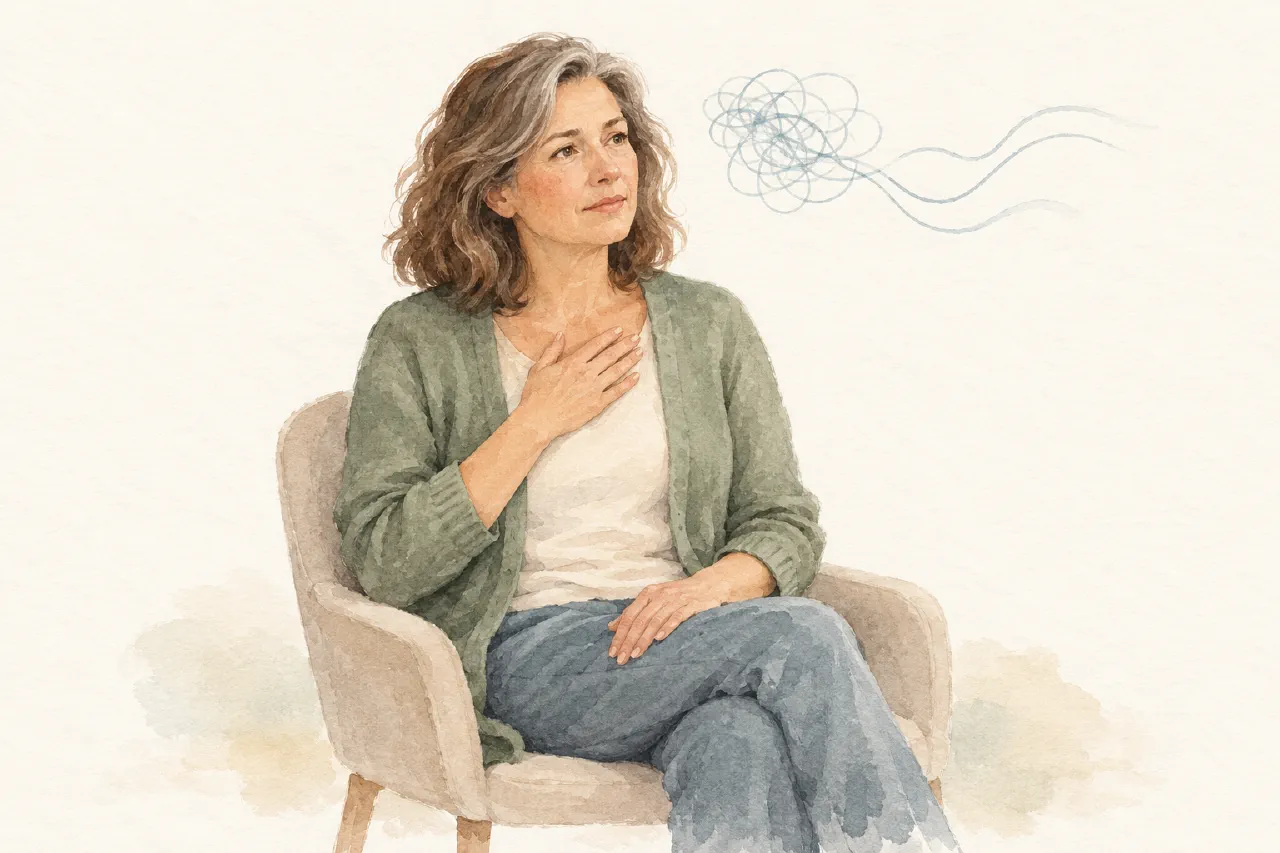
A few weeks ago, I had the absolute pleasure of joining the wonderful women at Sisterhood to talk about something that affects so many of us at different points in our lives - anxiety.
It was such a lovely couple of hours, and what struck me most was just how many of the women could relate to what we were talking about. Anxiety can feel incredibly isolating but a group like Sisterhood can remind us that we are not alone.
Anxiety can also make us feel as though there is something wrong with us. We can wonder why everyone else seems to be coping when we feel overwhelmed, exhausted, worried or catastrophising about the smallest of problems
But anxiety isn’t a sign that you’re weak. It doesn’t mean you’re failing and it certainly doesn’t determine who you are. When I’m talking about anxiety in either a group situation like Sisterhood or with 1-2-1 clients in my therapy room one thing I always like to make abundantly clear is that you do not have to live like this – there is a much happier, calmer alternative.
So, what is actually happening in our brains when we suffer with anxiety?
One of the things we talked about was the difference between our conscious and subconscious minds.
Our conscious mind is the part we use to think things through, make decisions and rationalise situations. But underneath that is our subconscious, or primitive brain, which is constantly scanning for danger and trying to keep us safe.
When life becomes too much and our stress bucket starts to fill up, our brains can begin to operate differently.
Work, family, relationships, finances, lack of sleep, hormones, health worries, never feeling like we have enough time… sometimes it’s not one huge thing that fills our bucket. It’s lots of little things, one after another.
And when that bucket gets too full, our brain can essentially say:
“Right. We’re under threat. We need to protect ourselves.”
Our survival brain starts to take over.
This can leave us feeling anxious, overwhelmed, irritable, exhausted and constantly on alert. We can start noticing everything that might go wrong, rather than everything that is going right. This is where we can find ourselves caught in a negative loop.
One anxious thought leads to another. We notice a physical sensation and worry about it. That worry creates more physical sensations, which creates more worry and suddenly our brain has gone into survival mode.
The important thing to understand is that your brain isn’t doing this because it is broken. It is trying to protect you and maybe sometimes, it has simply become a little overprotective. Understanding this can be a lightbulb moment for a lot of anxiety sufferers.
The good news? We can help our brains feel safe again.
One of the techniques I shared with the group was finger breathing. It’s incredibly simple, and you can do it pretty much anywhere.
Place one hand in front of you and use the index finger of your other hand to slowly trace up one side of your thumb as you breathe in.
Then trace down the other side as you breathe out.
Then move onto your next finger.
Breathe in as you move upwards.
Breathe out as you move downwards.
Continue around all of your fingers, allowing your breathing to become slower and more comfortable.
There is something really lovely about having something physical to focus on. Instead of getting caught up in everything happening inside your head, you’re bringing your attention back to right here, right now. Stick with it for a good while and you’ll find yourself calming down as your nervous system gets the message that you are safe.
We also talked about the importance of sleep. I know – it’s easier said than done when you’re anxious! But sleep really matters. When we’re constantly running on empty, everything can feel harder. Our ability to cope with everyday stresses can reduce, and our already-full stress bucket can become even fuller.
Sometimes the most powerful things we can do to combat anxiety and poor mental health aren’t complicated at all -
Getting enough rest. Getting outside. Moving our bodies. Taking a proper break. Talking to someone. Being kind to ourselves and giving ourselves permission to slow down.
One of the women at Sisterhood shared that she starts her day by walking 5K. She explained that it helps her feel as though she has already achieved something before her day has really begun. This helps her to cope better with the challenges that the day might bring.
I absolutely loved this.
It doesn’t have to be a 5K walk, of course! It might be ten minutes outside with a cup of coffee. It might be walking the dog. Putting your favourite music on and dancing around the kitchen. Going to the gym. Sitting quietly for five minutes. It’s about finding the things that help you.
You don’t have to just “put up with” anxiety
Perhaps the biggest message I wanted to leave with the women that evening was this:
You don’t have to accept anxiety as something you simply have to live with.
Anxiety might be part of your life right now, but it doesn’t have to define you.
Our brains are incredibly adaptable. We can learn new ways of responding. We can interrupt those negative thought patterns. We can teach our nervous system that it doesn’t always need to be on high alert. Sometimes, the first step is simply understanding what is happening.
So if you’ve been feeling anxious, overwhelmed or like your brain just won’t switch off, please know that you are not alone.
There is a reason you feel the way you do, and there are things you can do to help.
Be kind to yourself. Take a breath. Empty that stress bucket a little. Get outside. Talk to someone. Ask for support. And remember…
You are not your anxious thoughts. Your brain is simply doing it’s very best to keep you safe. With the right support and the right tools, it can learn that you ARE safe.
If you feel that anxiety has become something you’re constantly managing, you don’t have to figure it all out on your own. Solution-focused hypnotherapy can help you understand what is happening in your brain, calm down unhelpful thought patterns and build new, more positive ways of responding to life. My approach is positive, supportive and focused on where you want to go, rather than spending lots of time looking back at what has gone wrong. Sometimes, having the right support and a few simple tools can be the beginning of feeling more like yourself again.
Sending love and happiness always,
Georgina x
https://www.gtw-hypnotherapy.co.uk/